Design
A rectilinear stool constructed from four planar wooden components. The design explores how proportion, hierarchy, and perpendicular planes can create a stable structure capable of supporting the body with minimal elements.


Constraints
The stool was required to use a single length of poplar and consist of only four boards with no pierced cuts. The design also had to accommodate natural material conditions such as knots, warping, and irregularities while maintaining precise planar geometry.
Design Outcome
The final stool is composed of four interlocking planar boards that assemble like a puzzle, creating a self-supporting structure. Two angled openings pass through the form, forming “windows” that visually lighten the object while revealing how the planes intersect. The sides rise from the ground at slight angles, allowing the boards to lock into one another and distribute weight while maintaining a balanced, rectilinear composition.


Fabrication Plans
Although each student designed their own stool, fabrication was completed by another student using the provided technical drawings. Because the builder relied entirely on these plans, precise dimensions and clear assembly logic were essential. The project emphasized technical drawings as a critical tool for communicating design intent and enabling accurate fabrication.


Ideation
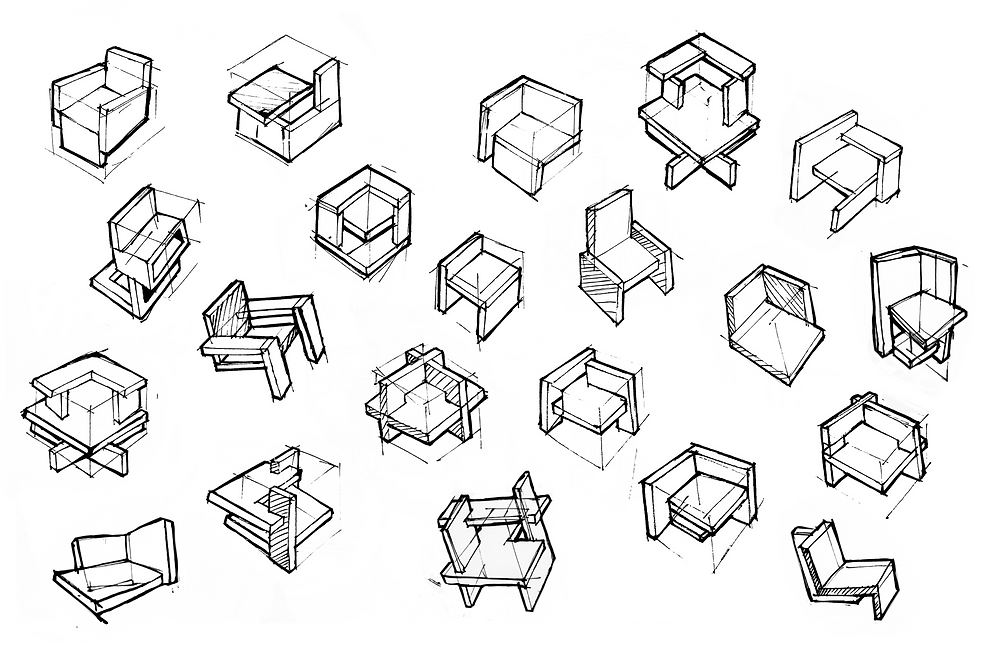
Early ideas were explored through sketching and quick models made from paper and white foam board. These studies tested different planar arrangements and proportions to find a configuration that was both structurally stable and visually balanced.